Thursday, September 06, 2018

Chapter 11. THE SALWEEN (NUJIANG): FROM BINGZONGLUO (丙中洛) TO CHAWALONG (察瓦龙)

                                                                                                      [Click here to go back to Chapter 10]
                                                                                                [Click here to go forward to Chapter 12]

[At Christmas 2007 I took my 9-year old son Paul to explore the Salween (Nujiang) river canyon... travelling via Dali to Liuku, Fugong and Gongshan then Bingzhongluo]

I found it hard to sleep in Bingzhongluo on the night before we set off to Tibet. Partly the excitement/worry and partly the lingering stomach cramps from those dodgy jiaozi dumplings from the day before. I woke up at 3.30am and got up to make a cuppa and read a bit of my last remaining bit of English literature, Graham Greene's The Power and the Glory.

Managed to get a bit more kip and then stirred a chatty Paul out of bed at 7.30-ish, while still dark outside, to get him washed and dressed before we went over to the Tibetan café over the road. Our driver “Tony” from Kunming was waiting for us and we had breakfast of mantou (steamed bread) with pickles, plus some hard boiled eggs before we set off. As it got light I did a bit of last minute shopping for biscuits and water while they filled up the Jeep with petrol.


And then at about 8.30am on this sunny December 23rd, we were off, driving down the side road all the way down to Chongding first, and past the Catholic church we’d visited the day before. It was slow going at first because there were quite a few road crews upgrading the gravel track into something suitable for ordinary cars. They are obviously grooming this place for an influx of tourists.

Soon we were past the tipper trucks duping concrete and muck on the road, and the first stop was right down by the riverside at a place called Shi Men Guan (Stone Gate Pass). At this point the high walls of the cliffs closed in around the turquoise slow-running Nu river and at this early hour much of the river was in shade and with mist over the water.
Nujiang north of Bingzhongluo, Yunnan

Further on up the river we crossed a new bridge and passed a few Lisu hamlets of log cabins on flats by the river.
Nujiang south of Chawalong, Tibet
bridge over Road on Nujiang south of Chawalong, Tibet

Shimenguan, Bingzhongluo-Chawalong road

The vegetation here was still lush and green, and the climate quite mild – but beyond Shi Men Guan there were few people and no traffic about.
We continued on the road up to the turn off for Qiunatong, some 18km up the road, admiring the spectacular scenery along the way.

Didading - near Qiunatong

Stopping at n encampment for more road workers, we then pressed on along a dirt track as the smooth road gave way to a bumpier, unmaintained track.

The Jeep bumped and jolted its way along the right hand (eastern) side of the river – occasionally turning a hairpin bend or following the road a little higher above the river – but nothing too scary – yet.

Road on Nujiang south of Chawalong, Tibet

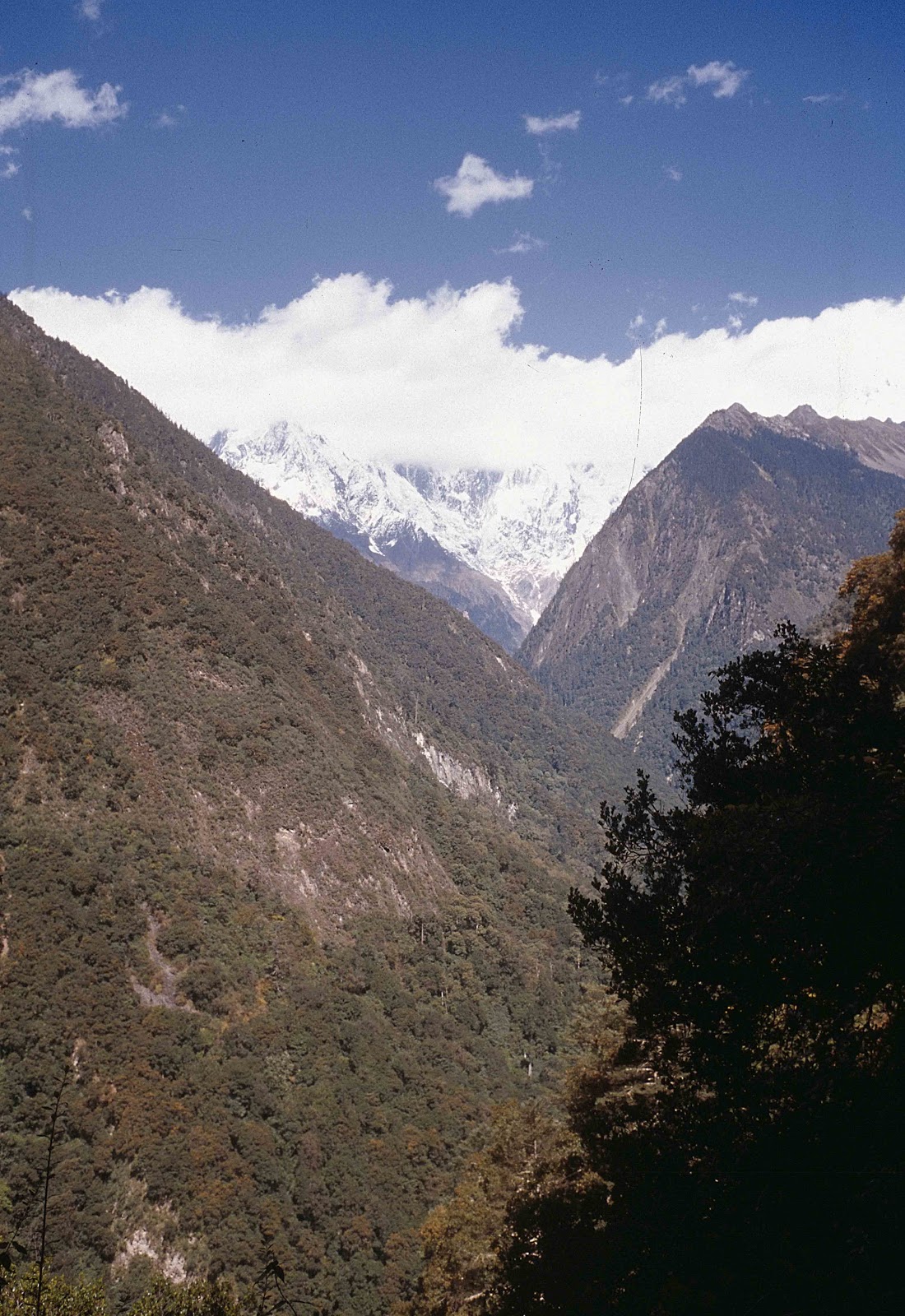
We got glimpses of snow covered peaks around corners and hiding behind the main range towards what appeared to be Burma. The scenery really was breathtaking, especially in the winter sun and under blue skies, and we seemed to have it all to ourselves.

peak above Nujiang north of Bingzhongluo, Yunnan

By mid morning we came to a pale blue sign that announced were leaving Yunnan and entering Tibet. Paul amused himself by jumping from one side to the other and chanting “Now I’m breaking the law, now I’m not.” We didn’t have Tibet entry permits.

We made it to Tibet

Some way up the road we came across our first Tibetan village of Longpu, where the style of houses was typically robust Tibetan, like small stone forts. Quite a contrast to the dark wooden log cabins of the Nu and Lisu a few km to the south. We noticed the landscape was becoming more arid, the hills apparently steeper and bare of vegetation, and the sky even bluer than before.

Nujiang waterfall

Bridge over Nujiang north of Bingzhongluo, Yunnan

After a short break where we ate more mantou and hard boiled eggs by the roadside, we pressed on along an increasingly dangerous road.

I had not expected this and it came as a rude shock to find that our route now lay along a precipitous ledge carved out of the sides of the steep cliffs. The road was barely wide enough for one car and the drop off at the side was all too frequently a sheer drop straight down into the river. The surface of the road was very bumpy and uneven, so each lurch saw me gripping the interior handles and grimacing at the prospect of a sudden slip off the road. To my alarm I found the doors were locked, so even my panicking plan to shoot out of the door should we come off the road would not be possible. I was terrified. The road just got worse and worse, and one of the bad things about it was that I could see the scary sections coming up in advance – in fact many of them looked much worse and more precarious from a distance than they really were in reality.

Nightmare road above Bingzhongluo

Paul was enjoying my discomfort and didn’t seem bothered by the risky nature of the road at all. As I sat there quaking and muttering “Oh God” or “Aiyah!” He just laughed and taunted me with: “Daaad – we’re going to fall off!”

The worst sections involved the road jutting out on a sharp spur over the river and then turning a tight corner to ascend or descend. I gripped the seat tightly and just closed my eyes and dare not to look or breathe.
I didn’t even dare think what would happen if a car or truck came the other way and we had to stop or worse, reverse.

I was not happy with the state of the road – in some parts the road appeared to be little more than a load of gravel tamped together tightly and shored up against falling into the river way below with just a few planks of rotting wood.

And just when I though we were over the worst an even more precarious section would come up.

Road on Nujiang south of Chawalong, Tibet

Needless to say I didn’t have much inclination to appreciate the fine views or the changing scenery.

Before I knew it we were in a very different arid landscape of fine white and grey dusty rock, massive steep slopes on either side, ending in jagged ridges. Cactuses grew along the roadside and the air appeared dry and thin. We passed a few Tibetan style cabins, some Mani stones and prayer flags, but for mile after mile the landscape was just barren of almost all forms of life – including vegetation. As Tony said, in these parts it may only rain two or three days in a year.
Tibetan house on upper Nujiang

Paul had by now nodded off and I cradled him on my lap as we crossed more ridiculously dangerous sections of ledge-road, until we eventually pulled up below a large white chalky landslip.

Chalky landslip on Chawalong road

landslip on Road on Nujiang south of Chawalong, Tibet

Landslip in Tibet, north of Bingzhongluo

Until now Tony had not appeared to be fazed by the state of the road, but here he got out and paced up and down, squinting up at the landslip and wondering whether it would be safe to cross below the buttressed wall that held back the huge mass of small stones. It took him a while to make up his mind that it was safe, and we go back in the car to edge rather quickly along this much swept route.

And then a few minutes later we were finally at Chawalong. The town appeared to comprise a picturesque cluster of traditional stone Tibetan buildings clinging to the hillside, and a more modern Chinese-style one street strip of sleazy and run down concrete building, tatty shopfronts and a few official buildings.

Chawalong, on the Nujiang

Tony asked the Tibetan guy who we had given a lift to for the last 5km where his friend lived, and was pointed to the far end of the traditional village.

And it was here that we pulled up, along an old cattle track, with instructions for me and Paul to keep out of sight until we knew which building we were staying in.
There were a few ragged looking girls herding goats and cows along these tracks, while others laboured along with large piles of sticks and branches lashed to their backs.

We finally got the all-clear and emerged stiff and reeking of nervous sweat form the Jeep, to walk up the grey gravel track to the house where Ma Huang’s local mate lived. A few local kids saw us and smiled/gawped before we reached the doorway and entered the dark interior of the Tibetan household. We had arrived in Chawalong.

 Chawalong, Tibet

Where we dined, Chawalong, Tibet

Inside the dark house we climbed up the rough wooden steps past a nasty looking German shepherd dog that was tethered in the rank-smelling straw of the ground floor. Upstairs we entered the black, barely lit large living room and joined the Tibetan family around a table. Some of the family, including a grandad with Buddhist prayer beads, were squatting round the big fire/stove in the middle of the room. But we were ushered to the table where we were given sunflower seeds and cups of warm Qingke barley wine, which our host assured us was their equivalent of water and was OK for kids to drink.

Chawalong interior 2

On the big TV they were watching some kind of Chinese male beauty pageant – in which bronzed sculpted gay-looking young Chinese men strolled across stage in just their boxer shorts, holding a couple of pink balloons. It was surreal.

Chawalong Tibet, north of Bingzhongluo

And this is pretty much how we spent the evening – watching crap Chinese TV (a program about a Chongqing-based cop drama) while the hosts chatted to Tony. I asked one guy what dialect of Tibetan they spoke, and he assured me they all spoke mandarin. I later learned he was just a lodger from Sichuan, and out-of-work guy who had moved to Chawalong because he preferred the easy life and relations with the Tibetans compared to the rate race of lowland Sichuan.

Chawalong interior

I asked a smart looking local Tibetan guy about the road, expecting some reassurance, but to my dismay he agreed that it was extremely dangerous because it was not an official road and therefore the local government did not maintain. The whole road was unstable, he said because the maintenance was done by local people on a voluntary basis. Only last month a group of Taiwanese and HK visitors had been killed when their vehicle came off the road, he told me.

Paul mooched round the house and made me nervous with his mischief – taunting the big dog, herding chickens, and throwing bits of waste maize to the pigs and chooks below form high up on the unfenced open roof.

We had dinner of chicken (the one we brought was beheaded, but Paul did not seem fazed by this at all), and I gobbled up much of the pork and chillies dish.

I had presumed we would be staying there that night, but at about 9.30-ish Tony suddenly announced were off, and we all traipsed over in the dark to a rickety wooden guesthouse on the main street, made form planks of what seemed like plywood.

On the way I broached the subject of my being nervous about the road trip back tomorrow, and Tony seemed surprised and hurt when I suggested there were some sections I might prefer to walk. He made some cold comment about being careful walking near the edge, and asked if it was his driving or the road that I didn’t have confidence in. I assured him it was the latter.

Walking down the main “street” of Chawalong felt like walking through the set of a western movie – as Paul remarked, all they needed was a Saloon Bar. On route we passed a couple of ‘nightclubs’ playing Tibetan and Eurotrash music, and within I glimpsed a group of Tibetan girls doing something that looked a line dance in a lounge with scenic pictures drawn on the wall.

A few locals shouted a friendly hello from the dark street sides – how could they see I was a foreigner in the dark?
Later on when I went back and peeped inside the other upstairs disco I found it to be full of rough looking Tibetan guys doing the same kind of arm over shoulder dancing, while others sat around at low tables strewn with hundreds of empty beer bottles, looking absolutely smashed. I didn’t linger to chat.

Instead I returned to get Paul settled down for the night, and to try sleep myself in the big dorm room we had all to ourselves.
I didn’t sleep well. I woke up at 3am again, my knees knocking and shivering with terror at the thought of those precipitous roads I would have to face one more time.

I picked up my book, The Power and the Glory, and quite appropriately reached the bit where the whiskey priest tries to prepare himself for death on the eve of his execution. “He woke full of hope, which immediately drained away …”.

I felt just the same and couldn’t rid myself of the mental image of those narrow ledges above the river. In my fevered imagination I even thought them likely to be too scary even to contemplate walking along, let alone driving. Would it be possible to walk back all the way in maybe three or four days? Or could I even get back by going north, further into Tibet and then doing a dogleg to Litang? That’s how petrified I was.

I managed to snatch a little more sleep until 7-ish, when I woke up and got dressed with false bravado on Christmas Eve, singing Christmas carols such as Hark the Herald Angels Sing to myself in an effort to maintain morale. Who was I trying to kid?

Near Bingzhongluo:
Peak on Bingzhongluo-Chawalong road

Long drop to the river:

Nujiang north of Bingzhongluo, Yunnan

Nujiang near Yunnan-Tibet border.Bingzhongluo-Chawalong road


Longpu, the first Tibetan settlent on the Nujiang:

Nujiang in Tibet, north of Bingzhongluo

Nujaing north of Longpu:
Nujiang in Tibet, north of Bingzhongluo

Landscape becomes more dry and barren as you go further north:

Nujiang in Tibet, north of Bingzhongluo

Dwarfed by the landscape:

Nujiang road from Bingzhongluo to Chawalong

The barren road to Chawalong:

Bingzhongluo-Chawalong road


Nujiang:

Road on Nujiang south of Chawalong, Tibet

Near Chawalong:


Road on Nujiang south of Chawalong, Tibet


Day 2: Return to Bingzhongluo

We didn’t hang around long in Chawalong on the morning of Christmas Eve. (If you want to see some excellent pictures of Chawalong, and portraits of the local Tibetan people by other photographers click here or here).

In the early morning light Chawalong looked even more grim than it had in the dark of the previous evening. Our guesthouse backed on to the edge of the river, and the slope down to the river seemed to serve as the local rubbish tip as well as outdoor toilet. A few curious locals came and gawked at us as we brushed our teeth, and I really just wanted to get out of there and get the scary road journey over with.


Once I was in the car I wasn’t too worried – it was all out of my control. We said our farewells and re-traced our route back along the bumpy road through the arid valley, past the landslip and then onto the scary sections of ledge road, way above the Nu river.

I don't like this road

It was bad, but not as bad as I’d expected. I made it easier for myself by sitting on the cliff side of the car, so I couldn’t see down the huge drop offs. And on the scary bits I stuck my eye in the viewfinder of the video camera and found that I wasn’t half so scared when I was seeing it as it was filmed – it was only when I looked at the real thing that I got the collywobbles again.

Road along Nujiang south of Chawalong, Tibet

Nujiang road to Chawolong, Tibet

And so we progressed back in stately fashion in the early morning sun. I was too preoccupied with taking pictures to get too nervous, and in fact I was almost enjoying it, especially when I thought we were over the worst.

Nightmare road above Bingzhongluo

"There, that wasn’t so bad after all …” I reassured myself.
Then round the next corner came one of the worst bits – a sharp turn round a section of road with a sheer drop off down to the river. I could have stayed in the car and managed it (honest) but I asked to get out and filmed the Jeep going over that section, and they waited a few hundred metres beyond to pick me up.

Nujiang road to Chawolong, Tibet

In fact Tony insisted that I tell him when I wanted to make more photos and he would stop the Jeep – so much so that we were making very slow progress because there were just so many scenic bits.

Nujiang road from Bingzhongluo to Chawalong

We passed bridges and cables over the rivers and even saw a couple of other vehicles on the road this time – a Jeep overtook us and a truck went past in a cloud of dust going up the valley. I wouldn’t want to be riding in that.
Nujiang river bridge


But there were no other people.
We stopped for lunch above the village of Longpu again and enjoyed the warm sun as we ate more boiled eggs and mantou by the car.
By early afternoon we were underway again and I had almost had too much of the scenery. Places where yesterday I would have gone into a frenzy of snapping I now ignored – I simply had too many picturesque views already.

Nujiang north of Bingzhongluo

I hunkered down in the back seat of the Jeep and swayed along as we entered what I thought would be the final strait of the voyage back to Bingzhongluo. We were approaching the border between Tibet and Yunnan, and with only about 50 or 60km to go, I expected to be back in town within the hour and soaking the dust and grime away in a hot bath. I was already thinking ahead to the evening, where we would spend Christmas Eve going down to the local Catholic church to see the Lisu people celebrate midnight mass.

But then the engine of the Jeep died and we rolled to a halt in the middle of nowhere.

Tony tried starting the car and at first I thought it was just a simple stall. But when the car engine would not turn over and was dead he stated flatly that we had run out of petrol.
Out of petrol, Songta, Nujiang south of Chawalong, Tibet


All of a sudden our plans were in turmoil. What did this mean – where were we and how were we going to get out of here?
Tony was quite calm and simply said that he would walk to the nearest settlement and phone down to Bingzhongluo to get the boss man, Ma Huang to come and bring us some petrol.

He set off to walk up the hill as we took stock of our position. We were on the lower reaches of the river, where the vegetation was lush and there were streams running down from the steep sided hills. Large dramatic snow peaks towered over us.

Nujiang south of Chawalong, Tibet

A short stroll down the road ahead of the car revealed some buildings ahead – so I rushed down to tell Tony, and he reversed course and headed off to try phone from there.

As we waited, me and Paul clambered down the 50m from the road to the edge of the Nu river – the first time we had actually been within touching distance of this mighty river. At this point it was slow and deep, but the currents looked strong – and eddies grew faster as the river soon narrowed into a section of rapids.

Beach holiday on the Nujiang

After half an hour of mucking about, throwing stones in the river, Tony returned with bad news. There was no phone down at the shack he had found, and the woman he’d met there said there were no other phones in other nearby settlements within walking distance. We would just have to wait until a passing car came through which could lend us the few litres of petrol to complete our journey, said Tony. That, or get them to pass on a message to Mr Ma Huang. But not to worry, he said, Ma Huang would act swiftly when we weren’t back by the expected time of 4pm, and so be up here to pick us up.

I believed his confident assurances and just settled in to watch over Paul, who was playing by the river bank making sandcastles on a sandbar. An hour past, it was now 4.30pm, and I still believed we would be back in Bingzhongluo before it got dark.

I mooched down to the shack a few hundred metres down the road and got chased by the woman’s vicious dog. I checked the story about the phone and asked her what the likelihood was of passing traffic – she just shrugged her shoulders.

Then I had a scare when Paul was doing his usual daredevil climbing/exploring – Shortly after I heard those dreaded words: “Dad - Look at me!” he slipped while climbing down from a tree hanging over the river, and banged his knee badly on a rock.

He was ominously quiet and I was all worry and anger with him, trying to explain that if he broke a leg here we would be absolutely stuffed, being two days walk from even the most basic first aid facilities. He sat, chastened, in the car and kept out of trouble for a while after that.

Another hour went by and I began to have my doubts about getting out of there in a hurry. It would be dark soon after 6pm and we had seen no other traffic. Tony suggested we move our stuff down to the shack from the car, and as we did a truck came up from Bingzhongluo. But of course he had only diesel, not petrol, and was of little use to us. I thought Tony might ask him to call Ma Huang, but he didn’t.

Songta Tibet, north of Bingzhongluo

We settled in to the tiny shack where the lady lived, invited in by her to sit around the smoky fire on tiny stools. Normally I might be quite angry or frustrated by such a last minute foul up and avoidable delay to my journey, but I just didn’t care right then. I was in such high spirits for having “survived” that dangerous road earlier in the day that I was euphoric and it just felt great to be alive – I just didn’t care!

Gongta, Tibet, where we spent Christmas

And this is where we spent our Christmas Eve. As it got dark I began to lose hope of getting out of this remote place, and settled in around the fire, trying to put a brave face on it. Paul seemed happy – flicking ash and sparks from the fire, poking the chickens that roamed around and prodding the cat, dog and the little piglet that shared our places around the fire.

Gongta, Tibet, where we spent Christmas


The woman was all hospitality. She boiled up a big cauldron of water on the fire and cooked us some noodles to which Tony and our Beijing woman companion added spam and a bit of green leafy veggies.
What a Christmas Eve this was turning out to be! Here we were in the middle of nowhere with absolutely nothing to do. No Christmas cheer in this little shack. The only diversions were a vicious fight between the resident guard dog and another dog that accompanied tow young lads who suddenly appeared from the night. They were the woman’s sons and seemed like really country yokels. Between them they beat the two snarling dogs violently with large sticks until one limped off whining to sit on top of the pig sty roof.

Christmas Eve in Tibet

After that me and Paul settled into a game of cards round the fire, playing blackjack, Uno and even snap – in the course of which Paul won about 80 kuai off me, much to his delight.
Gongta, Tibet, where we spent Christmas

When it was finally time to turn in the host offered us the use of her ‘spare room’, which turned out to be a cold shed that contained just an iron bedstead on which had been lain three rough planks, a blanket and a dirty duvet. That was all the bedding for four of us. Tony and the Beijing woman graciously offered the room to us, and they said they would sit up and try doze by the fire.

So I ended up pulling out the few other items of clothing from my bag and using them as extra mattress material, and settling down with Paul on the plans, huddling together to keep warm. I had to be careful to avoid two other hazards – a live electrical socket connected with bare wires and no plug – and the vicious guard dog which was tethered just outside our door – so I had to skip smartly away from its snapping jaws every time I entered or left the room.

Surprisingly I did manage to grab a few hours of sleep, but it wasn’t easy or comfortable, what with the hard planks digging in my back and Paul rolling over off the planks and taking the duvet with him.

I must have been asleep for two or three hours when in the middle of the night I suddenly heard the startling sound of a vehicle sounding its horn over and over, somewhere nearby. I dragged myself out of bed, and feeling vulnerable and scared, emerged from the shed into the freezing night air (remembering with a start to dodge the dog) and had a muddled conversation with a Tibetan guy asking where the boss was. I wasn’t sure if he was specifically looking for Tony or whether he was just a passing driver looking for a bed for the night.

Tony soon emerged, looking absolutely worn out from his smoky fireside stool vigil, and had a chat with the guy. He then explained that he would go with the driver in his truck down to Bingzhongluo and bring a recovery vehicle the next morning. Given the late hour and the danger of the truck travel on the road at night we would be better off going back to bed and waiting a few more hours, he said.
And so that’s what I did, thinking that help would be arriving soon after breakfast. Wrong again.

Gongta, Tibet, where we spent Christmas


And thus it was we awoke on Christmas morning, “Away in a Manger” – literally. No crib for a bed – just a few planks. And no room at the inn for these travellers, so we had had to stay amid the beasts, if not in the stable well at least in the tool shed. No wise men, just three very tired and weary travellers, eating instant noodles for breakfast. No gold, frankincense or myrrh. Just some leftover pickles, chilli sauce and a dusty bottle of past its sell-by date Pepsi from the woman’s meagre store.

As we waited for help to arrive she told us that she helped look after the local river monitoring station – it was only a very small affair, measuring river levels. She ran a little store selling noodles and cigs to make a few cents from the occasional passing truck or itinerant workmen passing through. She grew her own vegetables and her kids foraged and hunted in the surrounding forests – picking herbs and medicinal mushrooms when they were in season.
Nu boys at Gongta, Tibet

Gongta, Tibet, where we spent Christmas

The two young lads played with Paul that morning – sharing their catapult (which they later donated to him when they saw how much fun he was having with it, and wouldn’t accept any money for it). They also demonstrated their crossbow.

The morning dragged on and what little sense of adventure I felt over our “stranded in Tibet” escapade was now rapidly running out. Ten o clock and even the ever-patient Chinese woman was beginning to sigh. I began to have hallucinations. I would think I could hear the shifting gears of a truck and rush out on to the road only to realise it was the grunting of the pigs in the sty next door.

I walked up and down the road in both directions for a mile or more, with nothing to see except some of the most beautiful scenery in the world. I walked down to the rapids of the river, bushwhacking my way through brambles to get a good view, and then rock hopping to get as close as I safely could to the madly rushing torrent. And while I was down there I again imagined I could hear the roar of engines – hurrying back to the road once more, only to find deserted disappointment.

Gongta, Tibet, where we spent Christmas

Gongta, Tibet, where we spent Christmas

Lunchtime came and went – and our Christmas lunch was – surprise surprise – more instant noodles with hunks of spam from a tin.

This was getting seriously annoying and I was beginning to curse under my breath. What the **** was Tony doing? Was he just going to leave us here another day? Had he given up on his hope of 1000 kuai fee? Had he had an accident in the truck?

I was full of doubts by now and set 2pm as the deadline for action. I f nobody had arrived by then I would take Paul and set off to walk the 18km down to the nearest little settlement of Didadang. There, the woman told us, there was a basic guesthouse. I could do it in about four or five hours, she reckoned – but she had never walked with a dawdling eight year old.

I took another walk down to the river to take some more photos of nearby peaks, now that the sun was high in he sky and the valley was no longer in shade. Then I would pack all my kit and walk out of there.

Nujiang


On my return to the shed I was delighted to see a minivan – and then another jeep – help had arrived at last – almost 24 hours after we had first run out of petrol. We were saved.

Our actual departure form this isolated and beautiful spot was a bit of an anticlimax. First we had to wait more than another hour while they tried to refuel the Jeep and get it going. When this didn’t proceed too smoothly, they decided to evacuate us in the tinny little minivan. So we all crammed in and rattled off down the road after saying a final heartfelt thank you and farewell to the wonderful Ms Liu, who had welcomed us to her humble shack and shown the true spirit of Christmas in sharing all her meagre supplies and accommodation with us, the complete strangers.

The minivan was rude shock after the spacious, tough and well-suspensioned Jeep. It jolted us around and swerved dangerously near the edge of the track as its puny engine screamed and whined to drag us metre by metre back down the Nu river valley towards Bingzhongluo. I couldn’t complain though – it was getting us out of there, wasn’t it?

Nujiang north of Bingzhongluo

And so it was we finally hauled ourselves up out of the river valley at Bingzhongluo, back past the Catholic church where Lisu villagers were sitting about in the churchyard in their vivid Sunday best coloured costumes of pink, sky blue and yellow. I could have got out there and taken some great pictures and they finished off their celebrations, but I was just too physically and mentally exhausted. I stayed in the van, rode the extra 1km back up the hill into town and on arriving went straight up to our hotel room to soak all the smoke and dust off myself in the bath and shout: “I’m alive! I’m alive!” in a silly voice to no-one in particular.

It did feel good to be alive...

Peaks above Songta:
Snow peaks in Tibet, north of Bingzhongluo

Longpu from the north:
Nujiang road to Chawolong, Tibet

Nu village near Bingzhongluo (Shi Men Guan)

Wednesday, September 05, 2018

Chapter 12. KAWAKARPO KORA PART 1: THE DOKER LA (多克拉) PASS

                                                                                                    [Click here to go back to Chapter 11] 
                                                                                               [Click here to go forward to Chapter 13] 


In late 2012 I returned to north-west Yunnan for another attempt at the Doker-La pass and to try see Rock's legendary Lonjdre gorge. This time I brought along my two sons, Paul (13) and Andrew (15). Bringing along two truculent teenagers was asking for trouble, and I was to get it.


I’d originally hoped to do the kora round the Kawa Karpo mountains (Meili Xue Shan) with my previous Aussie trekking partner, Peter. However, we couldn’t match up our travel dates, and Peter had already set out to do the kora with three other Australians by the time I'd arrived in China with my sons in October. Starting out from my wife's family home in Guilin, we made our way to Deqin on a hard sleeper train to Kunming and then on buses via Lijiang.

The starting point of our trek was the Fei Lai Si lookout, near Deqin, which since my last visit in the 1990s had grown into a busy tourist village for sightseers coming to view Meili Xueshan. Fei Lai Si was now crammed with souvenir shops, restaurants and guesthouses boasting the best views of the mountain panorama. The local authorities had built an official viewing area for the mountain for which they charged a exhorbitant entrance fee. To prevent visitors from getting a free view by walking down the road they built a 12-foot high wall running right through Fei Lai Si that block anyone from getting a peek of the peaks.


We didn’t have this problem as we stayed at one of the guesthouses with a viewing area on the roof. At 6am in the morning it was packed with Chinese visitors all waiting with their cameras for the sunrise to hit Meili Xue Shan/Kawa Karpo. We were fortunate to have clear skies, and there was a rush of electric shutter clicks for 20 minutes as the sun’s rays first touched the tip of the Kawa Karpo peak and spread to the valley beneath.


There were also a few western tourists at Fei Lai Si, and most of them were planning to do the standard tour down to Yubeng and the Minyong glaciers, for which there was now an ‘admission charge’ of something like 200 RMB. However, we bumped into a cheerful Canadian guy from Calgary called Darren who said that he was also planning to do the full Outer Kora, and so we agreed to share a taxi ride down to the starting point at Chalitong and Yongzhi on the Mekong.

Arranging the ride was easier than we expected. At around 8am, when the sunrise-viewing crowds had dissipated, we asked a Tibetan driver of a minivan taxi if he would take us there. When he asked us our plans, we told him about our aim of doing the ‘big’ kora. His ears pricked up when I said that and he immediately replied by saying that Yongzhi was his home village and that he could make all the arrangements for horses and a guide for us to do the kora. After a few more questions and a bit of bargaining we agreed on a deal. We arranged to hire two horses and a guide from him for 340 RMB a day for a 10-day circuit of the mountains. The Tibetan guy seemed reliable and he assured us he knew the kora well  - and that one of his family would act as guide. Sorted!

Before too long we were crammed in his van along with all our bags, descending down a steep and twisting side road towards the Mekong river. From this point at the southern end of the Kawa Karpo range we had perfect views of the triangular snow peak Miyetzimu. At first the rough road descended in tight hairpin turns and zig-zags, and I recalled the perilous road that I’d travelled up on from Cizhong to Deqin some years earlier. However, our current road then joined up with a newly-built modern highway running parallel to the river – it was smooth, pristine and empty and we accelerated along quickly to south. The views of the mountain peaks and the Mekong from the highway were superb –if it had been in the US or Europe this road would no doubt be marketed as one of the most scenic highways in the world.


We whizzed along southwards for about fifteen minutes until we reached a simple suspension bridge crossing the river.  We paused there at a roadside shack at “Chalitong” while the driver chatted to some local Tibetans and told them about our plans. One of them spoke directly to me and warned us about police checkpoints along the road on the Nujiang side of the mountain.

Our circuit would take us temporarily from Yunnan into the Tibetan Autonomous Region before returning back over the mountain divide, and we didn’t have the necessary permits to enter Tibet. These were only granted to tour groups who wanted to travel to Lhasa, and could only be obtained in major cities such as Chengdu. We were banking on not getting caught by walking mostly along mountain trails and taking a chance that we would not encounter any police. However, there was one section of the Kawa Karpo circuit that ran along the road up the Nujiang valley for about 20km and through the village of Chawalong that we had visited illicitly by 4WD a few years earlier. The Tibetan man now warned us that there were new police checkpoints along this road to “Chana” as he called it – and that we would have to travel ‘after dark’ when they were unmanned.
Our Tibetan driver assured us that this wouldn’t be a problem and that his nephew knew how to get through the checkpoints.

The minivan crossed the river in the morning sunshine and we ascended what seemed like a thousand feet up the opposite side, up a dusty track amid scattered Tibetan houses and farmsteads. We eventually pulled up at the end of the track in Yongzhi, and disembarked into a small courtyard next a Hope Primary School where a few curious onlookers gaped at our heavy bags. The Tibetan driver took us into his house for lunch, where we were served butter tea, momo bread, pickled vegetables, mushrooms and something vaguely meaty that we assumed was chicken with lots of bones in it. The atmosphere was very friendly, and we chatted to the driver’s father about our family and our plans to do the full kora.

The driver left us in the care of his nephew, a young guy called Dorje, who he said had done the kora before and would guide us round the mountains. The circuit would involve crossing seven passes in total, the major ones being the Doker La on the way to the Nujiang and the Sho-La pass on the way back, both at altitudes of over 4000 metres.

“When you get to the top of the Sho-La my nephew can call me in Deqin – there is mobile phone signal reception there. Then I can come pick you up at the end of the track, so you don’t have to wait around for a few hours,” he said. It all sounded very well organised.

Before we set off I asked if they’d heard or seen anything of the four Aussie trekkers who were supposed to be in the area doing the kora at this time. After a bit of shoulder shrugging and conferring I was told that yes, there had been some foreigners going through on the trail recently - but they didn’t know when or where.

And so after lunch and the now familiar routine of saddling up the horses, we set off on the first leg of the Kawa Karpo kora. We had three heavy backpacks strapped on to the wooden saddles of the horses – they contained our three-man  MSR Mutha Hubba tent, sleeping bags and five days worth of food and cold weather clothes.

By contrast, Darren was travelling ridiculously lightweight. He carried his own pack, which seemed only half full, and was walking in running shoes and with a large umbrella that he used as a walking stick and to provide shade from the sun. He told me that he’d only brought a sleeping bag and a polythene sheet for shelter. Darren was experienced in the outdoors in Canada – he worked on glaciers doing landslip work, and he seemed to know what he was doing. As we were soon to discover, Darren was quite justified and capable in travelling light.


We started to ascend the hill above Yongzhi and were surprised to find that we were being accompanied not only by Dorje’s wife - a small but tough young 20-something year old women – but also the grandma of the family, dressed in her traditional Tibetan attire. She was a sprightly old lady and set a sure but steady pace on the trail, warning us not to overdo it as we’d damage our knees.

It was perfect weather for walking, and even in mid-October we were able to walk in shirtsleeves and enjoy the warmth of the sun. For the first couple of hours we walked steadily up a track above Yongzhi towards the south, - it was open scrubby country and we gained spectacular views of the Mekong valley as we got higher.


After a couple of hours we reached a ‘shoulder’, a pass where the track turned west and entered the Londjre gorge. Just before we left Yongzhi we’d seen the first of many groups of Tibetan pilgrims that we would encounter along the kora. It was a family group who had tramped up through the village carrying bedrolls, babies and kettles strapped to their backs.


They were dressed in everyday clothes, the women with long Tibetan skirts and many adorned with necklaces and bracelets and some even having the 108 plaits in their hair. Many of them carried thick sections of green bamboo as walking  sticks, with a neat trident array of leafs plonked in the top.

As we entered the Londjre gorge the trail started to run through old forest and we no longer had any views except for occasional glimpses down to the settlements in the valley far below us. But already I was being distracted from the views by the bickering between my two sons. They only had one iPod between them and couldn’t agree on whose turn it was to use it. When I tried to settle the dispute, the older son, Andrew, stormed ahead in a huff, muttering about how he’d never wanted to come on the stupid walk anyway. It didn’t bode well for the next ten days of the trek.


The rest of the afternoon was spent walking through forest on the side of a steep slope high above the Londre gorge. We didn’t see anything of the black spiralling corkscrew chasm track that Rock had mentioned in his writing. Perhaps that was on the lower alternative route that led up to the Doker-La.  The track had its ups and downs but wasn’t too strenuous. There were a few ‘mini-passes’ where prayer flags had been strewn across the branches and around the trail. There were also shrines where pilgrims had left all manner of items such as clothes, hats, watches, bracelets and sometimes renminbi notes. We passed a few other pilgrim groups and were wished a cheerful “Tashi Delay!”, a phrase we were to hear constantly repeated throughout the trek.


There were no villages or settlements en route, and for long periods we trudged along through the silent forest, wondering what lay ahead of us. As the hours went by I began to feel daunted by the prospect of the many long days of trekking ahead. It was hard to believe that in a week’s time, if we stayed on schedule, we’d still be only two thirds of the way through the trek and would still have three days walking yet to do.
My mood was not improved by the first sight of a place where I thought we might be staying overnight. Late in the afternoon we came to a place called Qu Xia, located beside the trail in the gloomy curve of a gully were a couple of makeshift wooden shacks covered with polythene o keep the rain out. Some Tibetan pilgrims were sat around a fire there, but it didn’t look like a very welcoming scene. They gazed at us, said a perfunctory “Tashi Delay” and I was glad when our guide signaled that we keep on going along the trail.


A couple of hours later we finally stumbled wearily into our first overnight stop at a place called Longna. It was a rocky clearing in the forest but there was barely any flat ground to put up a tent. There were two roughly-built temporary wooden huts. In one there was a fire going with a big cauldron of water on it steaming away, and a large flat undercover area where we could sit down and prepare some dinner. The fire was tended by a Tibetan guy who also seemed to be proprietor of a ‘xiaomaibu’ store in the next door cabin. It sold noodles, beer and a few other practical knick knacks such as cheap torches and lighters.

The store keeper was friendly and told me that another group of foreigners had recently come through. When I asked where they were, he pointed vaguely along the track and pointed towards the Doker La with his chin and lips in that typically Tibetan way. “Gone through – up there.”


We hauled our packs off the horses and started to prepare our fancy western meals with the help of boiling water from the cauldron. It was covered with a big flat lid and also had a ladle – but the water it delivered seemed a murky and tasted of smoke.
The fire smoke also pervaded the whole of the kitchen, rapidly inducing red eyes and fits of coughing in anyone on the wrong side of the fire.

While I faffed around unpacking my pasta and western cooking pots, Darren tucked into a simple bowl of three-minute noodles that he’d bought from the store, and he’d already moved into the ‘dorm’ before I had started cooking dinner. The dorm was another empty shack that had dry leaves on the floor and a plastic sheet for a roof. Dorje told us to grab a place to kip, and I immediately upgraded our lodging to ‘executive suite’ by purloining a few bits of flattened-out cardboard box to put on the ground beneath our sleeping bags. And it was just as well that we bagged good positions, because the deserted dorm soon filled up as other groups of pilgrims started to arrive. By the time it got dark at 8pm the place was full to bursting.


Andrew and Paul had already made themselves at home and were sitting around with their headphones on listening to their iPods and playing games on their mobile phones. Their big worry was that there’d be no electricity supply further along the trail and they wouldn’t be able to recharge their devices. They’d done really well on the trail on the first day, had no trouble keeping up and didn’t seem fazed by it at all. They took it all in their stride and didn’t particularly impressed by the setting or the cultural or physical uniqueness of the kora. Andrew, in his usual way, had immediately struck up a rapport with other young Tibetan guys around the camp. Despite his limited Chinese he was babbling away with them, comparing the technical features of his iPhone 4 with the phones of the Tibetans – many of whom also had smartphones.


As it got dark and everyone settled down to sleep I urged Andrew to get into his sleeping bag and get some sleep in preparation for the strenuous day ahead. By this time he had befriended one of the Tibetan mastiffs that was hanging around the huts and he was feeding it bits of the salami that I’d brought along for our lunches. Even in this remote spot Andrew could not shrug off his teenage habit of wanting to stay up late and trying to put off going to bed. “Just five more minutes dad – I’ve just managed to get the dog to let me pat him …”

I settled down to read my paperback (a bio of Laurence Olivier) in our airy dorm that was pretty much open to the elements. I was glad to have brought earplugs to block out some of the sound of Tibetan pilgrims chattering and coo-ing away all around us – and also to dampen the loud background roar of the nearby river.

Before we settled down for the night, I asked Dorje how far away we were from the Doker-La.  “Tomorrow ‘fang shang’ (reach the top)– a couple of hours away,” he said, before settling into his thin sleeping bag alongside grandma.


Day 2: The Doker-La

I managed to sleep reasonably well in our rickety dorm, despite the altitude. I had come prepared with a water bottle at the ready for my usual night-time wakings with a dry mouth, and had also made a nice ‘pillow’ from my down jacket. However, we were all woken up early as a group of pilgrims got up and left  in the dark at 4.30am. I dozed for a bit longer and then went to sit by the fire in the ‘kitchen’ shack, enjoying a cup of Nescafe. I was soon joined there by the storekeeper and an old Tibetan man who was slurping butter tea made by the usual plunger method.
The storekeeper grinned at me and pointed to the older man.
“You know that he’s the mafu (horse handler) for the foreigners ?”
I was confused.
“So what’s he doing here? I thought you said they’d gone up to the pass?”
“Up the trail, yes, but only five minutes away …” the storekeeper replied.
“You mean they camped HERE last night?”
“Yes!”
“So why didn’t you tell us?”
“Well, you didn’t ask …” he grinned.

A few minutes later I was walking up the trail in the pre-dawn darkness accompanied by the older Tibetan man. I was still carrying my mug of Nescafe when he pointed off the track to a couple of tents pitched about 50 metres away under trees on one of the few level sections of ground in the area. If he hadn’t shown me where they were I would never have found them.
I bashed my way through the undergrowth and when I reached the tents I called out
“Come on, wake up you lazy Aussie bastards!”

There were a few astonished mutterings from the dark tents and then a head popped out. It was Pete.
“Mike? So you made it! You must have flown up here!”
There then followed  a surreal fifteen minutes as I conversed with Pete in the dark and then was introduced to his wife and two other trekking partners John and Monica, whose heads also pooped out of the other tent. We had a lot to catch up on, and continued our conversation down at the kitchen over breakfast. It was such a weird and unlikely encounter, like a meeting of the local bushwalking club, but under the crest of the Doker La in Tibet.


It was soon daybreak and before we knew it our guide Dorje was urging me to get packed up and ready to leave. Pete and his companions were aiming to spend 12 days walking the kora rather than our ‘rushed’ ten days, and had planned to explore a bit more and do some side trips. So as our walking schedules didn’t match we said awkward farewells after we had struck camp, and our party headed off in front to try get over the Doker La ahead of them.

After a couple of false starts when we realised that we’d left hats and walking sticks behind, we were finally off to tackle the Doker La. The trail started off as a slow slog up through the forest alongside a large stream. It was another nice sunny day and I marvelled at the scenery that surrounded us as we gradually ascended to a large clearing in the base of the valley. We were surrounded by mountain ridges, and the forested slopes had waterfalls cascading through the beautiful autumnal colours. There was another pilgrim camp further up set amid a clearing  and we paused for a quick lunch. Andrew, as ever the awkward teenager, insisted on having noodles rather than crackers for lunch, which meant unpacking all the cooker and pans from the backpacks. By the time his noodles were ready the guide was already ushering us to pack up and move on.


We continued on up the river until we reached a second pilgrim camp in a series of open meadows with even more spectacular views of the surrounding mountains and forests. A sign proclaimed this to be the Doker La camp. From here, the track left the valley floor and headed steeply up the left hand (western) side of the valley.


As we slogged out way up out of breath and stopping every few yards, we were soon left behind by our Tibetan guides, who seemed to be able to walk at a constant and unrelenting quick pace – even the grandmother spinning her golden prayer wheel surged ahead of us. I was lagging at the back, partly because of my poor fitness and lack of acclimatisation to the altitude. I also had the problem of my boots falling apart. Foolishly, I had opted to walk in a pair of trusty old hiking boots that were comfortable but starting to show their age.  Now under the constant duress of the trail the sole of the right boot had started to separate from the boot and flopped about like a wagging tongue. The only thing I could do was to tie a spare boot lace around both the sole and boot tip. This wasn’t much of a solution as the lace kept slipping off and the toe of the sole would catch on rocks, bend back and peel back even further away from the leather body of the boot.


We continued up the trail, with the pass now looking tantalising close. But the distances were deceptive and it proved to be an even harder and slower grind up the last mile or so to the top. Nevertheless, I was pleased with my progress. A year earlier I’d broken my leg badly, sustaining a tibial plateau fracture and broken ankle when I was hit by a car while cycling home in Sydney. I had been three months off work on crutches and this was my first real trek since the accident. I’d done a few practice day walks and weekend trips around Sydney before coming on this trek, but nothing as rigorous as this. So far, my leg and its metal pins seemed to be holding up fine.


After about an hour of grinding up the gully in the side of the valley we eventually emerged into a hanging valley that led up to the Doker La. Now we could see the whole trail ahead of us, with the final section zig-zagging right up to the ridge line high  in the sky. I whooped with triumph. The Tibetans were sat waiting for us up ahead, and we paused for breath and sat to admire the views all around us.


Once I stopped walking I started to feel chilly and put a jacket on. However, once we got moving I found it too hot and restricting. And so, even at nearly 4000 metres in altitude in late autumn it was still possible to trek in little more than a t-shirt and shirtsleeves.

As we got higher and closer to the Doker La pass the track got steeper and zig zagged up the final few hundred metres. Ahead we could see a band of prayer flags completing smothering the ridge, and I started to get the jitters. I’d been told the slope on the eastern side of the pass was steep and dangerous, and was now beginning to get worried about what might lie on the other side. Our guide didn’t help. He pointed to my flopping boots and said: “Not good – you need a firm foothold on the other side – very dangerous!”

There was only one thing to do – go and see. But in the back of my mind I wondered whether it would be prudent to turn back if it looked too bad. I was especially wary of putting my kids at any risk. I could almost imagine the Daily Mail headline – “Pushy dad forces teenage sons onto fatal Tibetan trek.”

However, another side of me was terribly excited about the prospect of reaching the Doker La. I recalled that picture of Joseph Rock posing for a portrait photo on the pass, wearing his tweed jacket and sturdy boots, and with his hands firmly on hips. The Doker La! The official gateway to Tibet and the pass from whose heights Tibetans would fling themselves to their deaths, in the knowledge that they would pass straight into heaven from this sacred spot!


I reached the pass with Darren who now knew all about my long-held ambition to get here. Just before I stepped on the very top he laughed and said with mock solemnity: “Well Michael this is it – the moment of truth!”

I’d always imagined having a while to savour the atmosphere of the Doker La once I got up here, but when we did snake up those last few yards amid a sea of prayer flags, I had only a few brief moments on the pass itself. This was partly because there was barely anywhere to stop and rest. The pass was literally a knife-edge ridge, with just a metre or so of  flat ground on which to pause. Most of the area around the pass was festooned with impenetrable tangles of prayer flags, with only a passage wide enough for a horse to get through to the other side. I managed to get Darren to fire off a couple of quick pictures with my camera, but again the prayer flags blocked most of the view.


My other reason for not lingering on the pass was the sheer terror that I experienced when I looked over the edge on the other side. At first, it looked like a sheer drop with just a faint path indented into the side of the cliff. I dare not even descend the few yards it would require to take a closer look, and instead I pleaded pathetically with Darren to go ahead first. He went down and said that it looked ‘do-able’ – but by now I was getting into a right panic. I tried to stop the Tibetan guide Dorje from going over and told him that I didn’t want to continue, and that I wanted to turn back at this point. He looked at me as if I was mad and said the trail was fine. And with that, he headed off with the two horses in tow, stepping gingerly down the trail.


 Before I knew it, he had disappeared around a blind corner and was gone. I hollered after him and told him to stop. After a while he came back, alone and told me it was OK, and gestured that he would guide me down. And so it was I descended from the Doker La, literally having my hand held on some scariest and most exposed sections of the trail. As I edged along the track the guide gestured towards a thick rope nearby, stretching down the steep slope from the pass. “That’s the emergency rope for when it’s icy and frozen up here,” he said. “Pilgrims just hold on to it and go straight down …” To me it looked suicidal – perhaps it was the modern Tibetan way of entering heaven.

Soon we were over the worst though, and I then felt a mixture of exhilaration at having survived the steep descent and embarrassment for having been so easily scared. My two sons had descended unperturbed, wondering what all the fuss was about.


However, there was still a long and gruelling descent into a rocky basin, encircled by black and sinister-looking rocky ridgelines. I didn’t care. I had done the Doker La!

By the time we reached the bottom it was after 4pm and the guide was urging us to get a move on. He said it would be at least two more hours before we reached the next camp. It didn’t feel like that. I lingered at the back with Darren and we continued our descent down into a curving valley. I couldn’t stop taking photos and could hardly believe when I stopped and looked back at the Doker La that I had descended what looked like an impossibly steep slope.

 
As we caught up with the others I bounded along in high spirits and told them: “You realise we’re illegals now? We’re in Tibet without permits. We’re outlaws!”

An hour or so later we turned a corner and saw a couple of shacks in a clearing by the river on the valley floor below us. This was Zasutong, where we would stay for the night. When we got there, the place was already teeming with pilgrims – and many of the young Tibetan guys were delighted to see us. They spoke only a little Mandarin, but managed to tell us that they had come from Yushu in Qinghai to do this pilgrimage, and they all wanted to have their pictures taken with us – on the mobiles and digital cameras. How different from when Joseph Rock lugged his huge box camera and glass plates to take pictures of the pilgrims!

Rather than camp among the noisy and restless pilgrim groups in the large wood-and plastic-sheet dorm, I crossed over the river by a wooden footbridge and selected a level bit of grass and put our tent up there. Having brought the tent all this way it seemed a shame not to use it. But as with all camping activities, it seemed to require an inordinate amount of energy and patience to get the tent up and all the sleeping bags and mats sorted out. By the time I’d finished I was exhausted, which probably explained why I clumsily knocked my risotto dinner all over the floor while cooking it on my gas stove. I had to start all over again, but at least I could sip on some of the home-made red wine given to us by our guide Dorje – made from grapes cultivated in Yongzhi, he claimed. It tasted good and was just what I needed to finish off a remarkable day – meeting up with the Aussies on the Tibetan border and then crossing the Doker La.


After dark and a bit worse for wear, I switched on my head torch and wobbled back over the slippery log bridge that spanned the river, trying to find the tent. Even though it was only twenty yards away it was hard to find in the darkness. Before getting in, I paused to gaze in awe at the vast array of stars above in the perfectly clear night sky. It was a wonderful sight, especially when framed by the mountain ridges.


Day 3-4 To the Nujiang

It took us another two days to reach the Nujiang from Zasutong, and the walking was a bit of an anticlimax. After the spectacular scenery of the Doker La, the trail was mostly through thick forest with only occasional views of the surrounding valleys and mountains. We’d spent a cold night in the tent by the river in Zasutong and I slept badly, lying awake worrying about whether we’d be able to get through the checkpoint undetected at Chawolong. In the early hours I lay in my sleeping bag  envisaging being apprehended by the PSB and trying to think of some credible excuse that I could give them for being in Tibet without a permit. I also worried about the state of my boots, and whether they would hold up to another week of arduous hiking – and especially the big climb over the Sho La pass (说拉垭口) to get back to the Mekong valley. It was still hard to imagine that we would still be on the trek a week from now.
At 7am we got up and started the wearisome process of clearing out the tent and packing it up in the freezing cold pre-dawn darkness. The tent flysheet was covered in ice and all the things we’d left under the flysheet - such as boots and backpacks - were now frozen solid. I dispatched the boys over to the camp to get breakfast, but worried about them crossing the icy and slippery log bridge over the river. What if they fell in and were swept away? It would only take a minute or two in that icy water to bring on exposure and hypothermia.

As it got light we tucked into a rushed breakfast around the fire, and Dorje was already up and loading up the horses. The other pilgrims had already departed. We set off without further ado, but as usual I had to have a “shake down” after about 20 minutes of walking to sort out the most comfortable clothes for walking in and to rearrange how I was carrying my cameras.

The trail was through forest and went up gradually for a few hours up to another pilgrim rest station, where a young Tibetan woman was overseeing a small shop. She had a young daughter there with her, sitting on a bed. What kind of life must it be, I wondered, to be living alone in the middle of the forest for days on end?


No electricity or modern comforts, just a bed in a shack surrounded by boxes of noodles and drinks. Andrew was there before me and had already befriended the local dog, which looked fierce but was grateful for the bits of salami he was feeding it. Andrew donated his Angry Birds fluffy toy mascot to the little kid, who fingered it with amazement.

After a quick snack and drink we continued up the hill to a minor pass on a crest of the wooded hillside.  This pass – the Lu-ah-sen La- had the usual streams of prayer flags and items of clothing, beads and other trinkets. We nicknamed it the Bowl Pass, because previous visitors had also left scores of bowls of tsampa there as offering to the deities. However, the tsampa had obviously been there a long time as it had gone rancid, leaving a terrible pong about the place.

The rest of the day was spent in a long descent through the forest to a river camp called Chonating. The drop in altitude must have been substantial because my ears popped three times before I reached the river. As our guides walked at a faster pace we became separated during the long afternoon and as the day wore on with no sign of them I started to worry that we’d followed the wrong track.


Eventually, however, we bottomed out at the river, where I saw the guides ahead passing a few more shacks next to a bridge. We didn’t stop here, however. I managed to catch up with the Tibetan grandma, who didn’t pause but walked over the bridge, yodelling away as she continued to spin her prayer wheel. After another half hour we reached yet another group of shacks in the forest, and I saw with relief that Dorje had now halted and was taking the bags off the horses.  This was Upper Chonating, he said, and we would rest here for the night before tackling the next major pass the following morning, the one that would take us over to a village called Abing and the Nujiang.


“When we get to Abing we have to be careful,” said Dorje. “I’m a bit worried about police and checkpoints. We’ll have to keep a low profile.”

He then explained how he planned to hire a truck in Abing, which would take both us and the horses along the road after dark to a place beyond Chawalong, past all the checkpoints.
“It should be OK,” he said. “I know people in Abing.”


I tried not to worry about it. To keep myself busy I did a bit of washing of clothes in the nearby river, hanging up the socks next to the little store, and then treated myself to a bottle of beer for my efforts. Andrew loped up looking sorry for himself. He claimed to have been stung by something, and pulled up his sleeve to reveal a glaring nettle rash. Being an Aussie kid he had never seen northern hemisphere nettles before and had been brushing his hand against them as he sat on a low wall.

Soon it was getting dark and in my beery haze I admired the silhouettes of the other pilgrims made by the weak bulb against the dirty plastic sheeting walls. It was quiet except for the murmuring of the Tibetans and the distant roar of the river. This was about as remote as you could get - deep in the forest, separated from even the most isolated villages of Tibet and Yunnan by 4000 metre passes.  I tried to savour the moment, but just felt tired and uneasy about the days ahead.

Once again we spread out our sleeping bags on the leafy floor of the dorm and made ourselves at home for the night.


The next day was more of the same, walking in the forest - only this time uphill all the way. The track started ascending almost as soon as we left Chonating and continued on an unrelenting incline for the rest of the morning. The first couple of hours weren’t too bad, but by mid morning the altitude was getting to me and I was reduced to taking twenty paces and then stopping for breath.
Dorje wanted us to press on and would not stop for even five-minute break. He and his family pressed on, leaving me behind, and even the boys were able to make better progress than me.


Soon I found myself left behind. It was quite spooky being alone in the forest, because now there weren’t even any other pilgrim groups about. Over the last couple of days we’d crossed paths with various family groups of Tibetans – sometimes we would overtake them on the narrow trail, and then they would later catch us up during our rest halts and overtake us again, all accompanied by many ‘Tashi Delays’ and sniggers.


Some groups comprised three generations of an extended family: grandmas, young husbands and wives and kids, all lugging their belongings or babies on their backs.
Sometimes the pilgrims were just a couple of young guys, who would stop and take pictures of us with their Phones. On one uphill stretch I was embarrassed to be overtaken by a group of young Tibetan men that included one who was lame in one leg and had to be supported by a friend on either side. That’s how slow I was.

We paused briefly at a pilgrim way station half way up the hill, and I was already knackered. After a few crackers and a cup of tea made from boiled but strange-tasting water, we were off again. More uphill, and it wasn’t long before I was straggling behind again.

As the afternoon wore on and the sun got higher I ran out of water. There were no streams or other water sources and I was soon parched and gagging for a drink. I cursed the others for leaving me behind – my spare water bottle was in my bag strapped to the horse. By now the altitude was really affecting me – I was panting like a steam train, feeling dizzy and was only able to take ten steps at a time before having to rest. I started to call out for those in front to wait, but got no reply. Then I tried whistling with my fingers in my mouth, but my tongue was too dry to get any sound out. I began to despair – wondering how long I would have to wait before anyone came back to check on me.


Then, just when I was about to give up, I turned the corner and before me were a couple of makeshift shacks by the track, apparently deserted – the fire was out. I called out, but there was no reply. It was eerie. And yet the shop was stocked with all the usual food and drink, so I hopped over the counter and helped myself to a couple of bottles of grape juice. I took out 10 RMB and left it under another bottle as payment – and then noticed a few other people had done the same thing. There were notes of RMB left at various places in the shop by other honest bypassers. I wondered how long the proprietor had been away and when he or she would return.

I carried on up the track, refreshed by the much-needed drink, and about an hour later saw the first sign of prayer flags ahead. Was this the summit of the Sing-Kang La pass that had to be crossed before descending to Abing? I hoped so. Prayer flags were strewn throughout the forest and suddenly I stumbled across the rest of our party, all sat around, quite oblivious and indifferent to my advanced state of exhaustion. But it didn’t matter, because this was the Abing pass. We pushed our way along a narrow passage through the mass of prayer flags, to find ourselves on the edge of a ridge looking down on a cluster of buildings far below. It was like the view from an aeroplane window.


The mountain ridges receded into the distance, and across the other side of the vast canyon was the deep trench of the Nujiang. At last, we had crossed the main divide between two of the great river trenches of Asia! From here on it was downhill all the way to the Nujiang.

But first we paused to take a few pictures. As we did so, we were overtaken by a large group of Tibetan pilgrims. After the impression of being alone in the forest all day, it felt  weird to see that so many people had been following right on our heels. This was obviously a sacred spot for them, as they cheered, whistled and arranged their own offerings and strings of prayer flags.


However, we had an unpleasant encounter with one young Tibetan guy who objected to us walking backwards along the path to retrieve our day packs. In contrast to the friendliness shown by all the Tibetans we’d met so far, this guy had already displayed a truculent and surly attitude towards us when he first went past. He then plonked himself and his bag down near us and started scowling at us as we snapped away with our cameras. When I tried to go back up the track he stood up and blocked my way and gave me a filthy look, gesturing for me to turn around and go back down the track. I knew that Tibetans believe that you should only go clockwise around shrines, so I didn’t try to force the issue, and headed down the track for a few yards, waiting for him to move on. But he just sat there, glaring at us.

A few minutes later my son Andrew came back up the track to try retrieve some prayer flags he had left by the wayside. Again the Tibetan kid tried to stop him, but my headstrong teenage son just blabbed in bad Mandarin about having something to pick up and barged on past. The Tibetan guy looked furious and his expression was now pure murder. When he returned I had a big argument with Andrew about respecting the wishes of Tibetans, and at least waiting till the guy had gone, but he just shrugged his shoulders and dismissed my concerns, saying the Tibetan guy was “cool with it”.

Not waiting to confirm this, I hurried him on down the track, back through the forest, trying to get as far away as I could from the mad Tibetan guy. I explained to Andrew that a couple of years earlier in Kangding I’d seen a Han Chinese tourist attacked by a local Tibetan guy who’d been enraged when the Chinese guy ignored his warnings not to keep walking anticlockwise around a Mani stone shrine. The incident had led to a near riot as other Tibetans joined in, throwing stones at the minibus carrying the party of bewildered Han Chinese sightseers that included the one who had been slashed. When we caught up with Dorje and related the story he laughed and said it wasn’t disrespectful to walk anticlockwise around a shrine so long as you walked backwards and your feet were pointing clockwise.
“He was probably a just young punk jealous of you and your money,” he said.


We descended along a wide track out of the forest onto a dusty and open hillside, but Abing still seemed a long way below us  - and so it proved. It took us another couple of hours of knee-shattering descent before we even got close to the Tibetan village. The track veered this way and that and passed some wooden huts and a snooker table, where a few more Tibetan kids were hanging out with a motorbike. How the hell did they get it up here? I soon found out when they followed us down the slope, bouncing over the  rutted, rough clay soil between the stunted pine trees, tooting their horn.


It was late in the day when we finally traipsed into Abing, which was a picturesque Tibetan village perched on a small round plateau above the Nujiang river. My knees were shot and my boots were by now coming apart. I was glad to be down in a ‘civilised’ part of the world again, but also doubtful of continuing at this pace for another seven days. Dorje had been pushing us to the limit, and I was certain that I just could not continue at the same rate tomorrow. We needed a rest day. However, when I asked if we could take it easier the following day, Dorje shook his head said we were already behind schedule and would have to keep on at the same pace if we were to make it round the kora in ten days, which was my deadline. By now, Paul was also hobbling and limping, and found it hard to keep walking.


That decided it for me. Already worried about the prospect of getting nabbed by the police and worried about my disintegrating boots, I decided to see if we could leave the kora at the Nujiang and head south back into Yunnan. We could repeat our trip down the ‘road of death’ to Bingzhongluo from three years earlier.

And that is what we did. We hobbled into Abing to the surprise of many of the local residents, who stared at us from the verandahs and doorways of their Tibetan houses. Although it was a picturesque place, Abing now seemed to represent the worst aspects of ‘settled’ human communities. After the purity and comradeship of the pilgrim trail through the forest and mountains, Abing seemed idle, smug and indifferent.

And almost as soon as I entered the village I got a shock when I saw a man in a black police uniform riding up the hill on a motorbike towards me. I didn’t have time to react, but he drove past without paying me any attention. Maybe he was just wearing police-style clothes or was off duty, but it put the wind up me. When we reached the village centre, based around a couple of simple stores, I told Dorje that we wanted to drop out and head down to Bingzhongluo. Once I made it clear that we would still pay him his full fee for the circuit he assented with surprising ease, and quickly negotiated with the locals to hire us a minibus to take us down to Bingzhongluo.
Darren wanted to continue on the kora, so we arranged for a local guy to take him on the back of his motorbike past Chawalong after dark.

And so that was the beginning of the end of our Kawa Karpo kora and our Tibetan incursion. Within half an hour of arriving in Abing we had paid off our guide and said our farewells to Darren and were sat in a minivan being driven down a dirt track towards the Nujiang river. The track followed a turbulent tributary for a while before joining up with the main Chawalong-Bingzhongluo “highway”.

The Tibetan driver assured us that the road cut into the cliff was safe ( “so long as it hasn’t been raining”), but it turned out to be just as evil and dangerous as I remembered from three years previously.  I was terrified of the precipitous long drops straight down into the river from the edge of the narrow road, and winced when I saw how bad the road ahead looked.


As he drove, the driver kept up a low murmuring chant in Tibetan, just like the lamas in temples, but this did nothing to reassure me of our safety or benefit from divine protection. When he stalled the van on a narrow section of the cliff track and the vehicle lurched back towards the edge, I lost my composure and insisted on getting out and walking along the worst bit. Even walking the two-metre wide track was scary enough – I dare not approach the edge and its sheer drop back down to the river.

After a couple of hours we were over the worst sections of road and had passed the Yunnan-Tibet marker post, which now had a yellow sign which read “Strictly Forbid Foreigner Past This Point” in Chinese and something like “Forbid Foreigner Turn Into Strictly” in English. We settled down for another two hours of driving in the dark towards Bingzhongluo, and my two sons started arguing. I felt dispirited – I’d brought them along on this Tibetan jaunt thinking it might open their eyes to how others less fortunate than themselves lived, and that the trek might be a bit character building. I’d  hoped the trek might instill in them a little bit of self reliance and selflessness, but here they were still squabbling over some details of a video game that they’d been playing online. They were still just a couple of teenagers who’d been dragged on a boring trip by their dad.

As I was thinking this we passed the point in the road where three years before Paul and I’d been stuck for Christmas when our jeep ran out of petrol. Back then, there’s been just a couple of wooden huts by the road, but now there was a whole row of new concrete houses and workshops – it looked like the Chinese were pushing ahead with the dam construction on the Nujiang. Further on there was also a whole new tunnel that had been bored through the solid rock of the cliff. The Nujiang was no longer a pristine, unpopulated wilderness. God knows what it would be like in another ten years.

Bingzhongluo had also changed remarkably. Where before there had been a single and forlorn hotel on the main street there were now several Dali-style backpacker hostels and bars.
We arrived at 9pm and as we sought out a place to get something to eat, I realised I had seen enough of Joseph Rock’s travels. I had now ‘done’ pretty much all the Joseph Rock expeditions. I had been in his footsteps from Muli, Gongga Shan and Konkaling to Muti Konka, Choni and now the Great River Trenches of Asia. It had taken me twenty years on and off, but now I had done the lot. During that time, the places themselves had changed enormously – since the 1990s China had opened up, prospered, and embarked on a mammoth program of infrastructure development.  In the 1990s most of the places visited by Joseph Rock such as Yading and Gongga Shan were still ‘off the beaten track’ – many of them still without road connections and unvisited by westerners or even Chinese. Now there were new roads, hotels and tourist attractions everywhere and domestic tourism had taken off in a big way.

I was glad that I’d seen these places when they were still wild and unvisited. Perhaps I would re-visit some of them again for their natural beauty. However, I’d finally satisfied that nagging curiosity that had first been sparked by leafing through the pages of an old National Geographic magazine in the backroom of an Auckland library. I had been in the footsteps of Joseph Rock and re-discovered the ‘lost’ parts of south-west China and Tibet that he had first visited in the 1920s. I had confirmed the outstanding natural beauty of these areas he had shown in his photographs and I had met the modern-day counterparts of the ‘lost tribes’ of local peoples.  Contrary to his claims they had not died out or sidelined into wretched poverty, but had become part of the wider Chinese nation. The “hopelessly superstitious” Tibetans who as Rock observed “prayed without ceasing” now had iPhones and solar power. The wretched Pumi people he once dispensed medications to now went to medical school. The apathetic ‘aboriginal’ peoples of Muli had become internal migrants, moving to work in construction of factories in the east of China. The Huofo ‘Living Buddhas’ had been persecuted suppressed in the 50s and 60s but had now come back – many of them holding government positions. The Naxi dongba shamens and sorcerers of Nguluko were back in demand – available for weddings and tourist parties.